Weighted Lying Twist (Stability Ball)
Intermediate
Expert Advice
Long legs create substantial leverage even with a light ball. If control fades, bend your knees slightly rather than forcing a deeper sweep.
How-to-do Steps
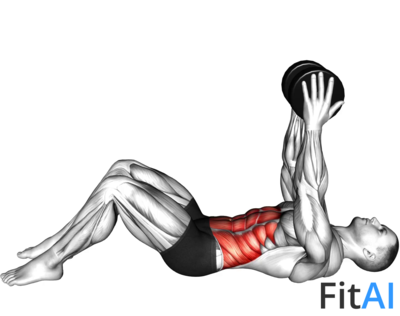
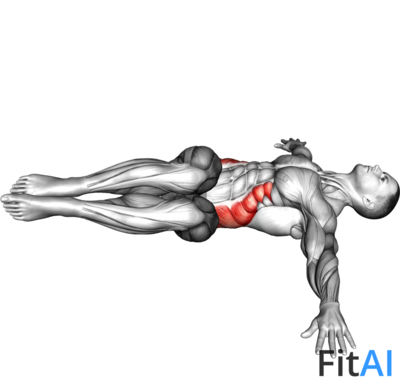
- Lie on your back on the floor with both arms spread outward, palms down.
- Hold the stability ball between your feet and raise both legs above your hips.
- Keep your knees mostly extended and press your upper back into the floor.
- Lower both legs together toward one side, stopping before either shoulder lifts.
- Exhale as you bring your legs and the ball back above your hips.
- Repeat on the other side, counting each sweep and return as one repetition.
Common Mistakes
- Ball slips between your feetFix: maintain gentle inward pressure throughout the movement.
- Legs swing through the centerFix: pause above your hips before starting the next sweep.
Coach Cues
Shoulders stay downLegs move togetherControl each sweep
Short reminders to keep in mind during every set.
Track Weighted Lying Twist (Stability Ball) in FitAI
Log your sets, reps, and weights automatically. Get AI-powered progressive overload recommendations and form feedback — personalized to your training history.
Muscles Worked
Weighted Lying Twist (Stability Ball) primarily targets the Abs, with Strength mechanics using Stability Ball. Understanding muscle activation patterns helps you focus on proper engagement and maximize training effectiveness.
Primary
Abs100%
Equipment Stability Ball
Exercise Type
Strength
Why Level 3?
Intermediate
Controlling mostly extended legs through rotation requires abdominal strength and coordinated trunk control.
Technique
Stability
Strength
Mobility
Impact
Learning
Sets & Reps Guidance
Beginner3 x 10-12
Intermediate4 x 8-10
Advanced4 x 6-8
Variations
Easier Variation
Frequently Asked Questions
What muscles does Weighted Lying Twist (Stability Ball) work?
Weighted Lying Twist (Stability Ball) primarily targets the Abs. It is classified as a Strength exercise performed with Stability Ball.
How many sets and reps should I do for Weighted Lying Twist (Stability Ball)?
For beginners, start with 3 sets of 10-12. Intermediate lifters can do 4 sets of 8-10. Advanced athletes can push to 4 sets of 6-8. Adjust based on your goals and recovery capacity.
Is Weighted Lying Twist (Stability Ball) suitable for beginners?
Weighted Lying Twist (Stability Ball) is rated as intermediate difficulty. Beginners may want to start with lighter loads or simpler variations and progress to this exercise as their strength and coordination improve.
What are the most common mistakes when doing Weighted Lying Twist (Stability Ball)?
Ball slips between your feet: maintain gentle inward pressure throughout the movement. Legs swing through the center: pause above your hips before starting the next sweep.